
What’s the real difference between sustamize and a traditional CO₂ database?
See how the two approaches differ across the dimensions that matter for procurement, cost engineering, product design and ESG.
We combine science- and industry-based CO₂ data with industrial cost-engineering expertise to provide carbon data that can be used directly across business functions.
Traditional CO₂ Databases vs. sustamize
Catena-X, compliant reporting
Why sustamize
Where conventional LCA databases fall short, and how sustamize closes the gap.
Traditional LCA databases provide emission factors, but often add complexity when data needs to be current, regionalized and usable across business processes.
Sustamize combines science- and industry-based CO₂ data with industrial cost-engineering expertise, making carbon data easier to understand and use across business functions.
Our datasets are regularly verified, updated and documented to provide a robust foundation for scalable carbon calculations.
- Procurement: Compare materials, suppliers and sourcing options from a carbon perspective
- Cost Engineering: Evaluate carbon alongside cost and other product parameters
- Product Design: Identify carbon hotspots early and compare alternative materials and production processes
- ESG & Sustainability: Support Product Carbon Footprints, Scope 3 calculations and sustainability reporting.
- Finance & Management: Bring carbon information into broader business and investment decisions
Instead of creating another isolated sustainability workflow, sustamize allows companies and software providers to integrate carbon data directly into existing systems.
Regularly verified, updated and documented CO₂ data provides a consistent foundation for Product Carbon Footprints and carbon-informed decisions across the organization.
Empowering Every User
Tailored CO₂e insights for every role, from ESG consutants to cost engineers.
Generate reliable product carbon footprints to identify emission hotspots and deliver targeted, data-driven climate strategies.
With the sustamizer®, ESG consultants work with transparent, credible CO₂e data to support informed recommendations.
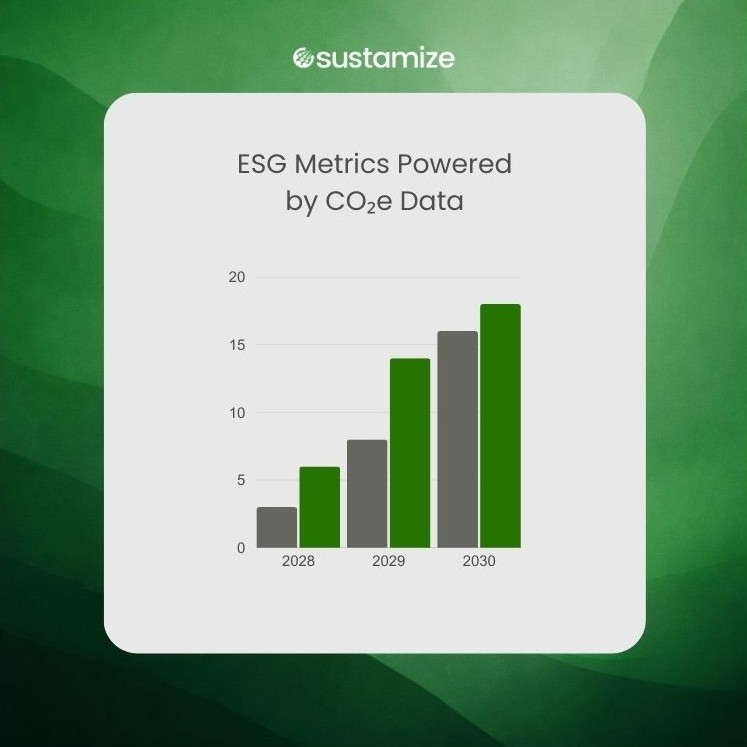
Embed validated CO₂e data into your costing tools to link product cost calculations with carbon footprint insights and support data-driven cost and sustainability decisions.
This gives cost engineers a transparent basis for informed trade-offs, efficient product design, and sustainable cost optimization.
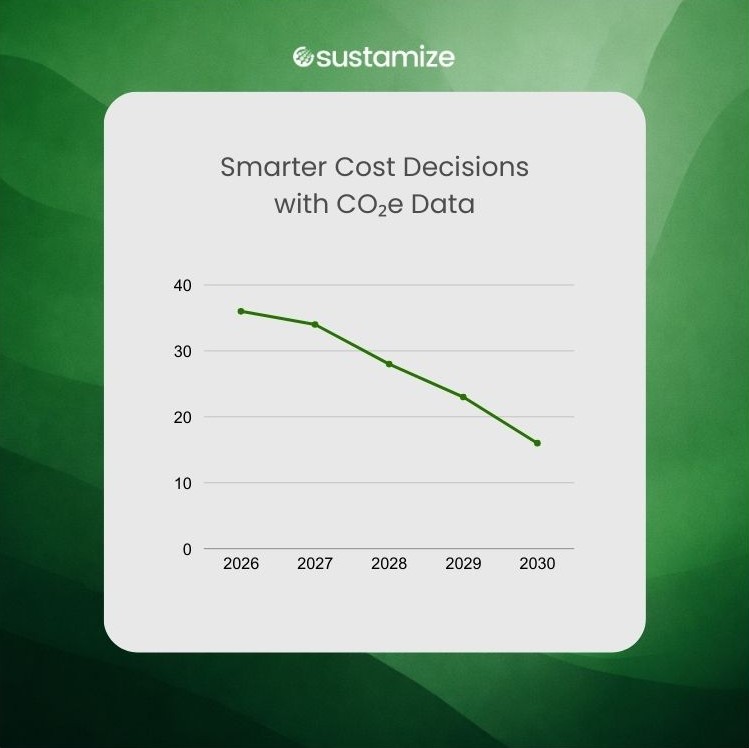
Use material-based CO₂e data to calculate upstream Scope 3 emissions, identify emission hotspots across materials and suppliers, and prioritize actions to achieve your net-zero targets.
Understand your supply chain's climate impact and make Scope 3 emissions visible.
Where Traditional LCA Databases
Reach Their Limits
Frequently Asked Questions
Learn how sustamize differs from traditional CO₂ databases and how companies can use current, regionalized and scalable carbon data across their business.
What is the difference between sustamize and a traditional CO₂ database?
Traditional CO₂ databases are often designed primarily for detailed LCA modelling and can require significant expertise to identify and process the right data. sustamize focuses on making carbon data easier to access, understand and integrate into business processes, with structured datasets, regional granularity and API-first delivery.
How up to date is sustamize’s CO₂ data?
sustamize updates its datasets twice a year to reflect changes in regional energy mixes, technologies, production conditions and supply chains. This helps companies work with data that better reflects current market conditions.
How regional is the carbon data provided by sustamize?
sustamize provides data across more than 240 countries and sub-regions, including more granular regional information such as US states and Chinese provinces. This allows companies to move beyond generic global or country-level averages.
Do I need deep LCA expertise to use sustamize?
No. sustamize is designed to make carbon data accessible beyond dedicated LCA teams. Parameterized and structured data allows users to create compliant Product Carbon Footprints and work with emissions data without relying on complex LCA software or deep LCA expertise.
Can sustamize replace a traditional LCA database?
That depends on the use case. Traditional LCA databases are often used for detailed multi-impact lifecycle assessments, while sustamize focuses on scalable carbon calculations and Product Carbon Footprints. For organizations primarily working with CO₂e data, sustamize provides a more business-oriented and easier-to-integrate approach.
Can sustamize be integrated into existing systems?
Yes. sustamize follows an API-first approach and can be integrated into existing systems such as procurement platforms, ERP systems, cost-engineering tools, ESG solutions, PLM environments and internal applications.
What types of CO₂ data are available in sustamize?
Sustamize provides emission data for materials, manufacturing processes, electronics, energy mixes, logistics, chemicals, standard parts, consumer products and recycling. This creates a broad data foundation for Product Carbon Footprints and carbon-related decision-making.
How does sustamize handle recycling and circularity data?
Sustamize provides granular recycling and circularity data across different materials and alloys. This allows companies to better reflect recycled content and end-of-life scenarios in carbon calculations.
Turn Emission Data into Action
Access reliable CO₂e data to calculate, manage, and scale Product Carbon Footprints across your value chain.

©2026 sustamize | Terms & Conditions | Privacy Policy | Imprint.