
Cost Engineering Meets Carbon Visibility: Sustamize x Indec
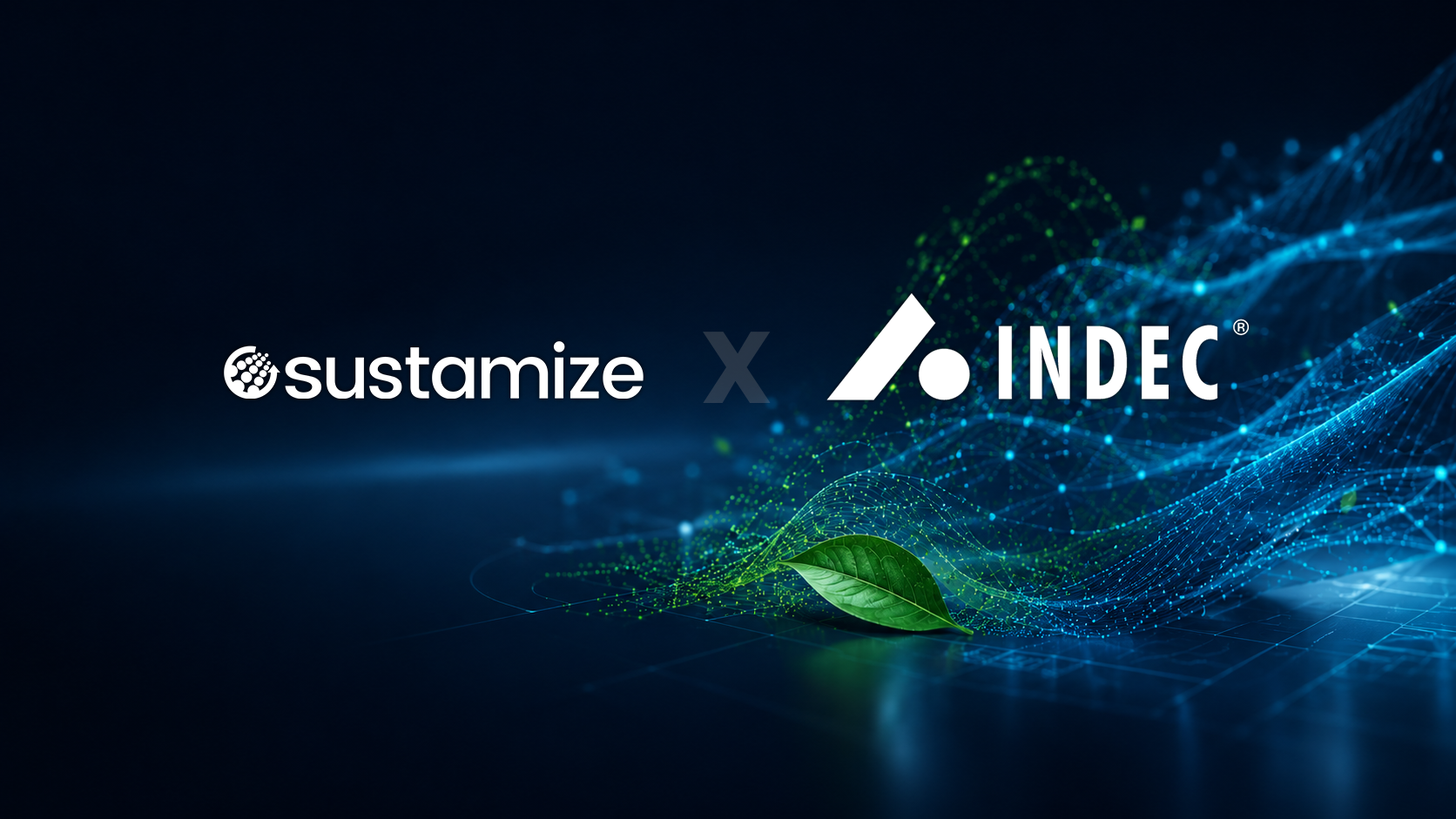
Bringing CO₂ into Benchmarking: The sustamize x Indec Partnership
For years, benchmarking inindustrial companies has been driven by one core question: How can we reduce costs?
Today, that landscape is changing. Executive leadership and engineering management are no longer just evaluated on cost, quality, or speed to market. Globally competitive organizations must now answer a new, complex dimension:
What is the carbon footprint of this product, and how does it affect the market positioning?
This shift is reshaping supply chain dynamics across Europe, North America, Asia, and global manufacturing networks. Large OEMs and international companies increasingly demand highly granular emissions data from their suppliers. Regulatory frameworks such as the Digital Product Passport, together with mechanisms like CBAM and other emerging sustainability requirements, are moving sustainability from a voluntary marketing initiative to a strict requirement during the early stages of product development. What used to be a compliance exercise has officially turned into a baseline requirement for doing business.
Consequently, manufacturing enterprises face a critical operational friction: the need to calculate, understand, and minimize their Product Carbon Footprints while maintaining strict cost optimization.
The Missing Link between CO₂ Data and Decision-making
Many organizations have already invested in carbon tracking, yet this data frequently remains underutilized. It sits in isolated enterprise systems, arrives in inconsistent formats, or is simply not available at the level of granularity required for engineering and sourcing decisions. While primary supplier data remains difficult to obtain at scale, companies still need reliable emissions insights across complex supply chains.
The primary operational gap lies in execution, but it often begins with a lack of accessible emissions data. While companies increasingly seek carbon transparency across their products and supply chains, primary supplier data is frequently unavailable, incomplete, or difficult to scale. Without a consistent and highly granular data foundation, internal decision-making processes, particularly within cost engineering and technical benchmarking, remain disconnected from sustainability metrics. Companies can generate high-level emissions report, but they struggle to convert those insights into engineering actions. To achieve real visibility, organizations must integrate carbon intelligence directly into their cost structures and product lifecycle data.
Building a Sustainability Data Foundation with sustamize
This is where sustamize plays a central role. With a clear focus on sustainability and carbon data, sustamize provides the foundation needed to make emissions measurable, comparable, and usable in real decision-making contexts. By offering structured, highly granular CO₂e data across materials, processes, and energy mixes, sustamize enables companies to move beyond fragmented datasets toward a consistent and scalable sustainability data layer.
At the core is a bottom-up approach: instead of relying on high-level averages, emissions are modeled along real product structures, from raw materials to manufacturing and end-of-life. This level of detail ensures that carbon data directly reflects how products are manufactured, making it immediately usable for engineering and benchmarking teams.
A key aspect here is data consolidation. Instead of depending solely on primary supplier data — which is often incomplete or delayed — companies can work with a robust secondary data baseline and enrich it over time. The goal is clear: no data gaps, even when supplier input is limited or unavailable.
To maintain relevance and accuracy, the database is continuously updated twice a year, reflecting changes in energy systems, materials, and industrial processes. In addition, recycling emission factors and end-of-life scenarios are integrated, allowing companies to better capture circularity and product lifecycle impacts.
This makes it possible to calculate Product CarbonFootprints under real-world conditions, despite increasing supplier pressure and growing data requirements. In this way, sustainability becomes more than a reporting layer, it becomes a usable data component that can be embedded into benchmarking, product development, and optimization processes.
A Holistic Approach to Product and Cost Optimization
While sustamize builds the underlying data baseline, Indec provides the holistic consulting expertise required to leverage this intelligence into a market advantage.
As an engineering and consulting partner, Indec supports manufacturing enterprises with deep technical benchmarking, should-costing, and value engineering. Indec analyzes products as complete systems, evaluating cost structures, design choices, manufacturing workflows, and performance in one integrated view.
This holistic approach is key. It ensures that decisions are not made based on a single variable, but by understanding how different factors interact across the entire product lifecycle.
By integrating sustainability data into this famework, Indec expands its strategic approach: cost optimization is no longer viewed in isolation, but in the context of carbon impact, regulatory requirements, and long-term product performance.
A New Way of Benchmarking: Cost and Carbon in One Model
The core value of the sustamize and Indec partnership lies in bringing together two perspectives that have traditionally been treated separately: high-quality sustainability data and deep cost engineering expertise.
When sustamize’s granular carbon data is embedded into Indec’s benchmarking and consulting methodologies, benchmarking fundamentally changes. It is no longer a purely cost-driven exercise, but evolves into a multidimensional analysis, where cost and CO₂ are evaluated together within the same product context.
This combination creates a much more complete understanding of products. Decisions that once seemed straightforward become more nuanced and, ultimately, more strategic.
- Identifying Cost and Carbon Gaps: A component that seems highly cost-effective on a bill of materials may carry severe carbon penalties upon deep-dive analysis. At the same time, a more sustainable alternative might initially seem more expensive, but reveal long-term advantages through process efficiencies, reduced material use, or increasing regulatory alignment.
- Uncovering Win-Win Opportunities: By connecting both dimensions, companies can clearly see where trade-offs between cost and emissions exist, and just as importantly, where they don’t. In many cases, this integrated view uncovers “win-win” opportunities, where both emissions and costs can be reduced simultaneously.
This exactly where the partnership creates realimpact. Sustamize provides the reliable, product-level carbon data, while Indec applies its holistic benchmarking and consulting approach to interpret this data within real product structures, cost models, and engineering decisions.
As a result, companies are able to move beyond isolated comparisons and start making data-driven decisions across design, sourcing, and manufacturing. Supplier evaluation also becomes more sophisticated. Instead of focusing solely on price, suppliers can be assessed based on their overall performance, including their carbon footprint — an aspect that is becoming increasingly critical as transparency requirements across the value chain continue to grow.
Integrating Sustainability and CO₂ into Product Development and Monitoring: The sustamize x Indec Partnership
Perhaps the most significant shift is that sustainability is becoming an integral part of how companies design, evaluate, and monitor their products. This partnership marks a fundamental change in how industrial organizations approach product development and portfolio management.
CO₂ is no longer just a metric for annual sustainability reports. It is increasingly becoming a core decision parameter for engineers, procurement teams, and product managers during the earliest stages of product development. Cost, performance, and carbon impact must now be considered together to create products that remain competitive in a rapidly evolving market.
Because decarbonization is an ongoing operational process rather than a one-time initiative, products must be continuously monitored, adapted, and optimized throughout their lifecycle. By combining granular carbon intelligence from sustamize with Indec’s holistic benchmarking and consulting expertise, companies gain the ability to evaluate products through both a cost and carbon lens and identify optimization opportunities earlier in the decision-making process.
Industrial companies that fail to integrate carbon intelligence into their benchmarking and product development workflows risk falling behind—not only from a sustainability perspective, but also economically. Organizations that successfully combine carbon transparency with disciplined cost engineering are better positioned to respond to customer requirements, regulatory expectations, and changing market dynamics. In doing so, they secure a decisive and sustainable competitive advantage.
Because ultimately, the goal is not just to measure carbon, but to use it as a lever for smarter, more competitive, and future-ready products.
Want to understand the true cost and carbon impact of your products?
Learn how granular sustainability data and holistic benchmarking can help you uncover optimization potential, improve decision-making, and build more competitive products.

Start Your Free 14-Day Trial
Explore our database, AI-powered tools and Product Carbon Footprint solutions.
.jpeg)
Turn Emission Data into Action
Access reliable CO₂e data to calculate, manage, and scale Product Carbon Footprints across your value chain.

©2026 sustamize | Terms & Conditions | Privacy Policy | Imprint.