
How Is AI Transforming Life Cycle Assessment (LCA) and Product Carbon Footprint Calculations?
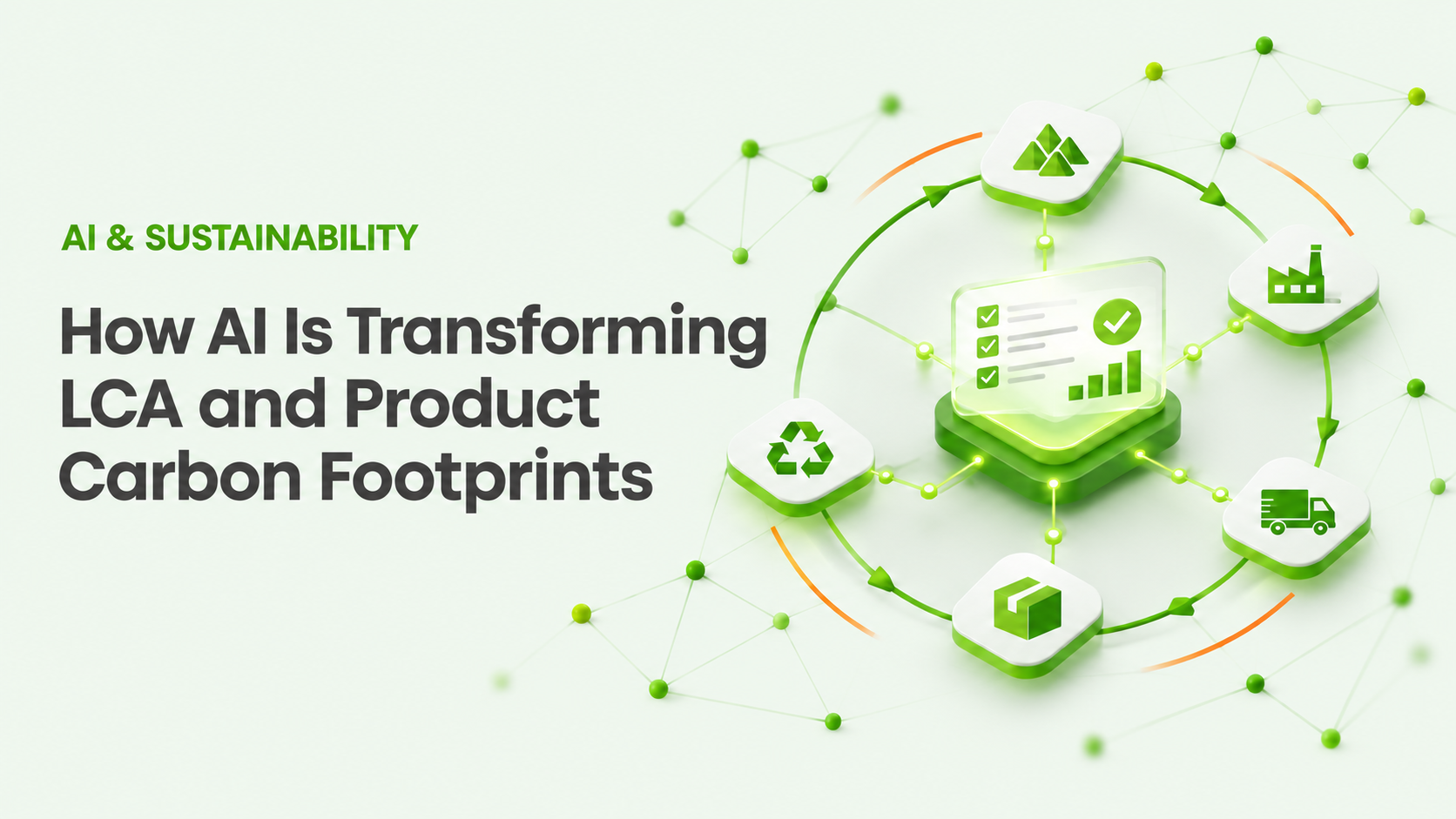
Beyond AI Hype: Solving the LCI Data Bottleneck
Topic about AI in sustainability, the conversation usually stops at corporate carbon accounting like tracking Scope 1 and 2 utility bills or categorizing expense receipts. But for those of us working directly on Life Cycle Assessment (LCA) and Product Carbon Footprints (PCFs), we know the true bottleneck isn't basic accounting. It’s the scarcity of Life Cycle Inventory (LCI) background data and the time-consuming process of database creation.
At sustamize, our data team has been tackling this challenge head-on: building our own AI-powered LCI database and developing an AI-driven LCA data provider platform. Through this work, we've seen firsthand how AI can move beyond industry hype to become the backbone of scalable LCA calculations.
The Biggest Challenge in LCA: LCI Data Scarcity and Manual Mapping
This has become a real problem when calculating an accurate PCF across complex supply chains specially because the data comes in every format imaginable, for ex; unstructured supplier PDFs, raw material specs, and incomplete bills of materials (BOMs). Traditionally, an LCA practitioner has to manually parse each document, hunt for appropriate secondary datasets and manually map every single process flow. It’s slow, tedious, and hard to scale when a company has hundreds of SKUs.
Worse yet, huge gaps exist in secondary LCI data for regional supply chains and emerging manufacturing processes, leaving practitioners guessing or relying on poor proxies.
How Can AI Generate Life Cycle Inventory (LCI) Data?
Rather than treating AI as a simple shortcut that takes an input and guesses an end result, we are using AI to build structured, unit-level foreground processes that form a reusable background database. For a deeper look into our approach, read our blog post on AI-driven LCI data generation.
1. Generating Foreground Processes at the Unit Level:
First, AI assists in defining and structuring individual foreground unit processes (the specific inputs, outputs, emissions, and resource flows for an activity).
2. Methodology and Guardrail Checks:
As unit processes are constructed, the AI continuously validates them against explicit methodological rules, ensuring compliance with our cut-off approaches, system boundaries, and allocation principles.
3. Building a Reusable LCI Process Database:
Once a unit process is generated and validated, it becomes a modular, reusable building block in our process-level LCI database. This data can then be referenced across different materials, products, and supply chain models.
4. Automating LCA and Product Carbon Footprint Calculations:
With a robust, rule-checked LCI process database established, we can execute precise, automated LCA calculations across entire product portfolios.
The Elephant in the Room: Verifiability
In LCA modeling, "hallucination" or unchecked assumptions are fatal. If an AI engine generates flawed process flows without adhering to strict standards, the integrity of the entire assessment crumbles.
By embedding methodological checks directly into the process-generation stage, we ensure verifiability:
- Automated Rule Enforcement: System boundary rules, allocation logic, and cut-off criteria are checked algorithmically before data is finalized.
- Human-in-the-Loop Validation: Certified LCA practitioners maintain oversight, validating low-confidence flows and complex allocation decisions.
- ISO 14040/14044 Compliance: Data Quality Indicators (DQIs) — including temporal, geographical, and technological representativeness — are tracked transparently at the individual process level.
The Limitations of AI in Life Cycle Assessment: Transparency Over Perfection
We have to be completely honest about technology: AI is not flawless, room for error and hallucinations still exists, and being fully open about these challenges is our top priority. Specially process details might not all available on the internet for AI to track down. However, amid all the AI hype, we also need to address the other elephant in the room: today, the industry heavily relies on outdated market averages and generic LCI datasets that fail to reflect modern technology, often leading to flawed decisions and false scenarios.
The world needs to move from reporting to climate action and the way the way to do it is via product designing and engineering perspective. Our goal with this approach is to pioneer a real alternative that pushes towards LCA or PCF data into real action.
The Future of AI-Driven LCI Databases and Scalable LCA
Using AI to revolutionize LCI data isn't about claiming we have created a flawless "black box" that solves sustainability overnight. It is about building a disciplined, continuous framework where software speeds up unit-process creation, algorithms enforce methodological rigor, and human experts ensure scientific truth.
By being open about accuracy limits while systematically tackling data bottlenecks, we can move closer to a reality where reliable, high-resolution LCA data is accessible at the speed and scale the planet needs. And even with the risk of early errors or hallucinations along the way, we won't stop refining the possibilities behind automated, high-resolution process data.


Start Your Free 14-Day Trial
Explore our database, AI-powered tools and Product Carbon Footprint solutions.


Turn Emission Data into Action
Access reliable CO₂e data to calculate, manage, and scale Product Carbon Footprints across your value chain.


©2026 sustamize | Terms & Conditions | Privacy Policy | Imprint.